

Stay in Your NZ Home During Renovation, Plan 3–6 Week Room Phases


Staying home through a single-room renovation is realistic for most households; a full-home job is a different proposition entirely. Whichever you’re facing, one rule doesn’t bend: you need a working bathroom and a functioning cooking or washing area at all times. Before demolition starts, check if your home predates 2000 and test for asbestos.
TL;DR:
Phasing the renovation so only one critical room is offline at a time minimizes living disruption and keeps essential facilities operational.
Confirming asbestos testing and removal before demolition is crucial for safety, especially in homes built before 2000, to avoid legal penalties and health risks.
A dedicated, dust-proof safe room helps maintain sleep quality and mental stability amid noise and upheaval during the project.
Detailed contracts should specify staged deadlines, working hours, entry points, and cleanup commitments to prevent miscommunication and protect your daily life.
Using a managed renovation service can simplify coordination, ensure licensing compliance, and handle permits, helping reduce stress and improve project efficiency.
Table of Contents
Planning your renovation timeline and budget before demo day
Ask for a demolition-to-handover schedule before you sign anything. This document should show exactly which weeks your kitchen or bathroom will be out of action, not a vague “6 to 8 weeks” estimate. Without it, you’re flying blind on when to book time off work or arrange somewhere else to shower.
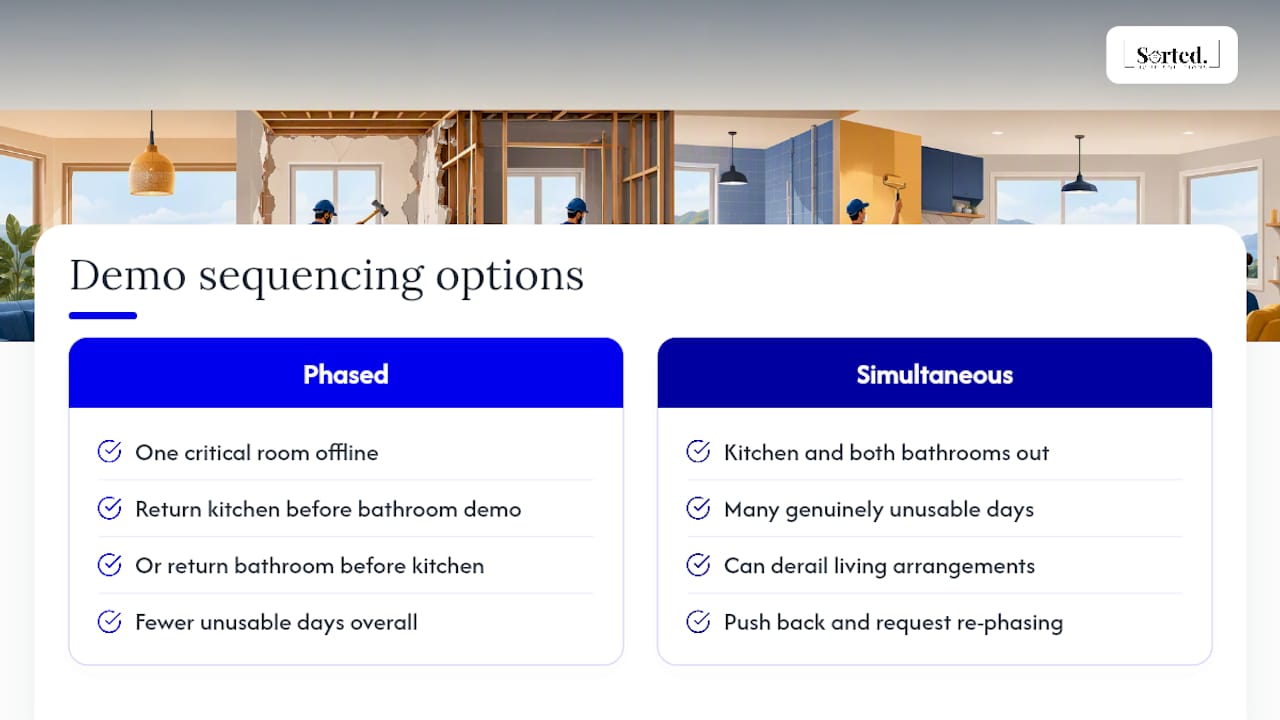
The smartest sequencing keeps only one critical room offline at a time. Experienced project managers often return the kitchen to use before starting bathroom demolition, or vice versa, which cuts the number of genuinely unusable days you rack up. If your contractor’s schedule has the kitchen and both bathrooms out simultaneously, push back and ask them to phase it differently.
Confirm three things before work begins: building consent is lodged and approved where required, your home and contents insurance covers the renovation period, and you’ve set aside a contingency fund of a moderate percentage on top of the quoted price. Renovation surprises are the norm, not the exception, and a contingency buffer stops a discovered rot problem or wiring issue from derailing the whole project financially.
Check that every trade on site is licensed, and identify early which specialists you’ll need. Asbestos testing, plumbing alterations, and electrical work all need particular qualifications, and lining these trades up before demo day avoids costly downtime waiting for the right person to become available. Checking your insurance cover at this stage, rather than after work starts, saves a lot of grief if something goes wrong.
How do you set up a temporary kitchen and bathroom?
Pick one room, ideally the furthest from the work zone, and seal it off as your safe space. This becomes your dust-free retreat: bedding, a chair, phone chargers, and anything that helps you decompress at the end of a loud day. Keep the door shut and resist the urge to use it for storage overflow.
A functional temporary kitchen doesn’t need much. A fridge, microwave, kettle, toaster, and a solid bench cover most meals for weeks at a time. For dishwashing, the laundry tub works well, or a large plastic tub with a drying rack does the job just as easily if your laundry is also out of action.
Set this up before demolition starts, not the night after your stove disappears. A ready-made temporary kitchen plan built over a weekend beats scrambling for a jug kettle at 8pm.
For bathrooms, you have three realistic options:
A temporarily plumbed shower or portable shower unit, if your contractor can arrange one.
An arrangement with neighbours, family, or a nearby gym for showers during the worst days.
A short, targeted stay elsewhere just for the days when the bathroom is completely gutted, rather than the whole project.
Before you rely on any provisional setup, check power loads (temporary kitchens on one extension cord trip circuits fast), confirm hot water access, and make sure waste and drainage are actually connected rather than improvised.
How do you manage dust and know when asbestos means calling in professionals?
Containment isn’t optional if you’re living on site. Plastic sheeting, taped seams, zip-wall systems at doorways, and floor protection keep dust in the work zone rather than drifting through your hallways and living areas. Ask your contractor to set up a single entry point with a dust lock rather than multiple open doorways.

Ventilation matters just as much as containment. Good practice means exhausting dust and fumes straight outdoors, not just opening a window into the rest of the house. If your builder’s plan doesn’t mention where extracted air goes, ask.
Asbestos is where DIY enthusiasm needs to stop. If your home was built before 2000, particularly anything from the 1980s or earlier, assume asbestos-containing materials are present until tested. Under New Zealand’s Health and Safety at Work (Asbestos) Regulations 2016, anyone conducting a renovation must identify asbestos likely to be disturbed and remove it, so far as reasonably practicable, before work starts. Getting this wrong carries real penalties, and more importantly, real health risk.
If you suspect asbestos, don’t disturb it and call a licensed removalist rather than scraping, sanding, or cutting into it yourself. Disturbing suspected material to “just check” is the single most common way people expose their household to fibres unnecessarily.
Pro Tip: If your contractor mentions asbestos and multiple rooms need opening up at once, or utilities will be cut repeatedly across several days, that’s your cue to book a short stay elsewhere rather than push through.
What should go in your renovation contract to protect your daily life?
Get these written into the contract, not agreed verbally over a coffee:
Staged completion dates for each critical room, particularly the kitchen and bathroom.
Daily working hours and agreed black-out periods for the noisiest work, so you can plan to be out of the house.
Which doors trades use for entry and exit, and where tools and materials get stored overnight.
A commitment to end-of-day cleanup, including dust and rubbish clearance before they leave site.
Ask for a day-by-day staging chart rather than a single end date. This is the same document that shows you when the kitchen comes back online, and it should be updated whenever timelines shift.
Set one single point of contact for the whole job. Chasing five different tradespeople for updates is exhausting and a recipe for miscommunication. Agree on a regular check-in, weekly at minimum, and a clear escalation path if defects appear or deadlines slip.
Before signing, confirm who’s responsible for filing building consent paperwork, that every trade carries current licensing, and that your insurer has been notified of the renovation dates. A gap here can void cover exactly when you’d need it most.
How do you cope day to day without losing your mind?
Protect your sleep above almost everything else. If your safe room has a door that shuts, use it, and keep your morning coffee ritual or evening wind-down exactly as it was before the tools arrived. Small routines anchor you when the rest of the house feels unrecognisable.
Plan short escapes deliberately rather than waiting until you’re desperate. Book the noisiest days off, stay with friends, or take a weekend away timed to coincide with demolition. Managing renovation stress well often comes down to protecting one sanctuary space and pacing yourself with planned breaks, rather than gritting your teeth through the whole project.
Noise-cancelling headphones, an eye mask for daytime naps, and a decent air purifier in your safe room all earn their keep. For decisions, set a pause rule: nothing tile-related or expensive gets decided after 6pm or when you’re exhausted. Keep a simple decision log so you’re not relitigating choices you already made three weeks ago.
Your week-before checklist
Before the first hammer swings, work through this:
Containment: confirm plastic sheeting, zip-walls, and floor protection are part of the quote, not an afterthought.
Temporary kitchen: fridge, microwave, kettle, toaster, and a dishwashing setup ready to go.
Asbestos: testing commissioned if your home predates 2000, with a licensed removalist on standby if needed.
Insurance and consent: both confirmed in writing, contingency fund set aside.
Contacts: single point of contact, emergency numbers, and a temporary shower plan for the worst days.
Typical sequencing runs roughly 3 to 4 weeks for a bathroom and 5 to 6 weeks for a kitchen when phased properly, giving you a realistic window to plan around rather than guess at.
What actually got us through a noisy kitchen renovation
The one habit that mattered most was ring-fencing a single calm room from day one and treating it as non-negotiable, no tools, no dust, no exceptions. Renovation fatigue is real and entirely normal; it doesn’t mean the project or the relationship is failing. That one room kept our sleep intact and, frankly, kept us talking to each other through six loud weeks.
— Rudi
Let Sorted Home Solutions run the logistics for you
A managed renovation service can be an alternative to juggling five trades and a spreadsheet yourself. Coordinating asbestos checks, consent paperwork, and daily site management on top of your own job is exactly the burden that turns a liveable renovation into an exhausting one, and it’s the gap Sortedhomesolutions is built to close.

A managed renovation service typically offers one point of contact instead of coordinating with multiple trades, licensed trades managed for you, and consents handled as part of the job rather than left on your desk. Kitchen and bathroom work is offered across tiered packages, from Kitchen Grade A, B and C options through to full-scope work on the full home renovation and flood restoration page. If your list is shorter, smaller jobs like vanity swaps, sealant refreshes, and patch repairs are handled without a full renovation contract. Request a demolition-to-handover schedule and a fixed-fee quote to help plan your renovation effectively.
Where to check the details yourself
Verify the rules and practical guidance directly from these sources before your renovation starts:
Asbestos in the home — WorkSafe New Zealand guidance
Health and Safety at Work (Asbestos) Regulations 2016
Living through a renovation — Auckland | Superior renovations
Sources
FAQ
Can you live in your house during a renovation?
Yes, for most single-room or staged jobs, provided you keep one working bathroom and one cooking or washing zone available throughout. Full-home renovations or jobs involving extensive asbestos removal are much harder to live through safely, and a short-term move-out is often the better call.
What adds the most value to a house in NZ?
Kitchen and bathroom renovations consistently rank among the highest-value updates because they’re the rooms buyers scrutinise most closely. A well-sequenced renovation that keeps the home liveable during the work, rather than one that drags on with rooms shut for months, also protects the property’s appeal if you need to sell partway through.
What does a $10,000 bathroom remodel look like?
At that budget, expect a refresh rather than a full strip-out: new fixtures, retiling a portion of the space, updated vanity and sealant work, rather than moving plumbing or walls. For a scoped quote on your specific bathroom, current pricing tiers are the most accurate starting point.
How much would a full house renovation cost in NZ?
Full-home renovation costs vary enormously depending on scope, age of the property, and whether structural or asbestos work is involved, so there’s no single reliable figure to quote here. Sortedhomesolutions provides fixed-fee quotes after an on-site assessment through its full home renovation service, which is the most reliable way to get a number specific to your home.
Recommended
Comments